
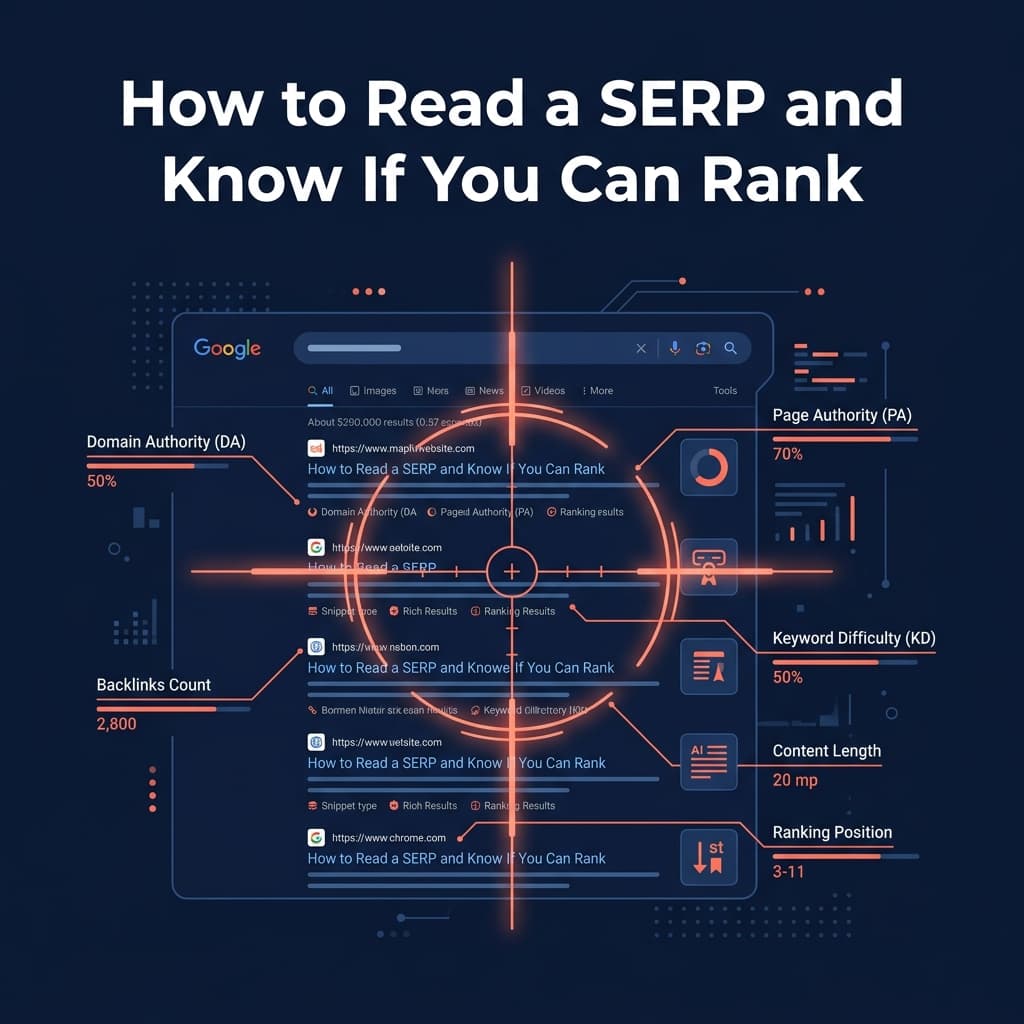
There's a number in every SEO tool that tells you how hard a keyword is to rank for. It's usually wrong in interesting ways.
Not fabricated — it's mostly measuring the link profiles of the pages currently ranking, which is a real input. But it can't see whether those pages are any good, whether they actually answer the question, whether they're four years out of date, or whether an AI Overview has already eaten the top third of the screen.
Ten minutes of reading the actual results page tells you more than the score does. Here's what to look at.
The short version
Open the query in an incognito window and answer five questions:
- Who's ranking? — domain profile of the top ten
- What format wins? — the shape Google expects
- How good is the content? — click through and read
- How much page is left? — SERP features above the organic results
- Does the intent match what I'd write?
Four signals mean walk away, and they're at the bottom.
Always use incognito
Personalised results will lie to you. Your own site ranks higher than it does for anyone else, because you visit it constantly. Your location and history shape everything.
Incognito, or a logged-out browser, gets you closer to a neutral view. Not perfect — location still applies — but usable.
Question 1 — Who's ranking?
Look at the domains, not the pages.
Walk-away pattern: Wikipedia, Amazon, major news publishers, and government sites occupying most of the first page. Those positions aren't available to you on any realistic timescale.
Opportunity pattern: a mix of smaller specialist sites, older blog posts, forum threads, and Q&A pages. Forum results in particular are a strong signal — if Reddit or Quora is ranking on page one, Google is telling you it couldn't find a good dedicated page for this query. That's an invitation.
The nuance most people miss: what matters is whether a site like yours can compete, not whether the domains are big. A specialist site with 200 focused pages on one subject can outrank a much stronger generalist on that subject. Domain authority is a tiebreaker, not a gate.
Question 2 — What format wins?
Look at the shape of the top results.
Step-by-step guides? Comparison tables? Tools? Videos? Product pages? Long definitional explainers?
The dominant format is Google reporting what satisfied searchers. You can beat it by being better within that format. You rarely beat it by being different — if ten results are comparisons and you publish a definition, you've misread the query.
Also note the age of what's ranking. If everything is from 2022 on a topic that's changed since, that's an opening. If the top results were all updated this year, the field is being actively contested.
Question 3 — How good is the content actually?
This is the step people skip, and it's where the real information is.
Click into two or three top results and read them properly.
Signals it's hard:
- Genuinely comprehensive, well-structured, current
- Original data, custom diagrams, real first-hand experience
- Clearly maintained rather than published and abandoned
Signals it's beatable:
- Obvious padding around a thin core
- Outdated screenshots, dead tool references, stale statistics
- Generic advice with no specifics — no numbers, no names, no examples
- The answer buried on screen three behind an introduction about nothing
That last one is common and exploitable. A page can rank on links alone while burying its answer — and a page that answers immediately, with specifics, is both a better result and a better citation candidate.
Question 4 — How much of the page is left?
This has become the most important question, and it barely existed a few years ago.
Count what sits above the first organic result:
- Ads
- An AI Overview
- A featured snippet
- People Also Ask
- Video carousel, image pack, local pack, shopping results
On some queries, position one is most of a screen scroll down. Ranking first there is worth dramatically less than ranking first on a clean results page.
Worth knowing the scale: Ahrefs analysed 300,000 keywords and found that when an AI Overview appears, click-through for the top-ranking page falls by roughly 58%.
This doesn't mean abandon those queries. It means weighing the effort against a smaller prize, and thinking about whether being cited in the AI Overview is the actual goal. More on that.
Question 5 — Does the intent match?
Final check, and it catches a surprising number of doomed projects.
Look at what's ranking and ask: is this the page I was planning to write?
If you planned an explainer and the page is full of comparisons, you have two options. Write the comparison instead, or accept you're targeting a query that doesn't want what you have.
Arguing with the SERP is expensive. Google is showing you aggregated behaviour from everyone who's searched this term. Your assumption about what they want is a sample of one.
The four signals that mean walk away
1 — The top ten is all major authority sites. Wikipedia, Amazon, government, national news. There's no room and there won't be.
2 — The content is genuinely excellent and actively maintained. If beating it means matching a research team's output, pick a different query. This is the honest one people avoid.
3 — SERP features have consumed the page. AI Overview plus featured snippet plus ads plus PAA means the organic prize is small.
4 — The intent doesn't match your business. You could rank and it would produce nothing you want. High-traffic irrelevance is still irrelevance.
Any single one might be survivable. Two or more, and your time is better spent elsewhere — there are always adjacent queries with the same audience and less competition.
Does domain authority decide everything?
No, and the belief that it does stops people trying things that would work.
Domain authority is a third-party tool metric, not a Google ranking factor. Google has no single site-wide authority score it applies to your domain.
What genuinely matters:
Topical authority beats general authority on specific subjects. A site covering one subject thoroughly can outrank a stronger generalist on that subject.
Page-level relevance and links matter more than site-level metrics on any individual query.
Query difficulty varies enormously within a domain. The same site can be unable to touch a head term and rank first for its long-tail variants.
The practical read: use domain metrics as a rough sense of whether you're in the same league as who's ranking. Don't use them as a reason not to try a query where the current results are weak.
A ten-minute worked pass
For "email blocklist removal," say:
- Incognito search. Note who's on page one.
- Domains: a mix of ESP blogs, deliverability vendors, and a couple of specialist sites. No Wikipedia, no Amazon. → possible
- Format: how-to guides with steps. → write a how-to
- Content check: two of the top three are vendor blogs with a soft product pitch and no actual removal process. → beatable with genuine detail
- SERP features: People Also Ask, no AI Overview on this query. → organic prize intact
- Intent: someone with a live problem, which is exactly who I want. → good fit
Verdict: worth writing, and the angle is the specificity the vendor posts avoid.
That whole pass took ten minutes and told you more than a difficulty score.
Frequently asked questions
How do I know if a keyword is too competitive?
Read the results page rather than trusting a difficulty score. Too competitive looks like major authority sites across the top ten, genuinely excellent and actively maintained content, SERP features consuming most of the screen, or all three. Winnable looks like older content, thin vendor posts, forum threads ranking, or top results that don't quite answer the question.
What are SERP features?
Anything on a results page that isn't a standard organic listing — AI Overviews, featured snippets, People Also Ask, video carousels, image packs, local packs, shopping results, and ads. They matter because they push organic results down the page and often answer the query outright. Counting what sits above position one tells you how much the top ranking is actually worth.
Does domain authority decide everything?
No. Domain authority is a third-party tool metric, not a Google ranking factor — Google has no single site-wide authority score. Topical authority on a specific subject often beats general authority, and query difficulty varies enormously within the same domain. Use it as a rough league check, not a reason not to try queries where current results are weak.
What to do next
Take the keyword you were about to write about and spend ten minutes on the five questions above.
Most people find one of two things: the query is more winnable than they assumed because the current results are thin, or it's less winnable than a difficulty score suggested because an AI Overview has taken the page. Both are worth knowing before you spend a day writing.
Free: The SEO audit checklist.
Related guides
- Keyword research without expensive tools — the wider process
- Long-tail keywords — where to look when the head term is closed
- SEO when AI answers the question first — when the prize has shrunk
Join the Newsletter
Get practical marketing tactics delivered straight to your inbox.

Written by
Muhammad Basim
Related Articles
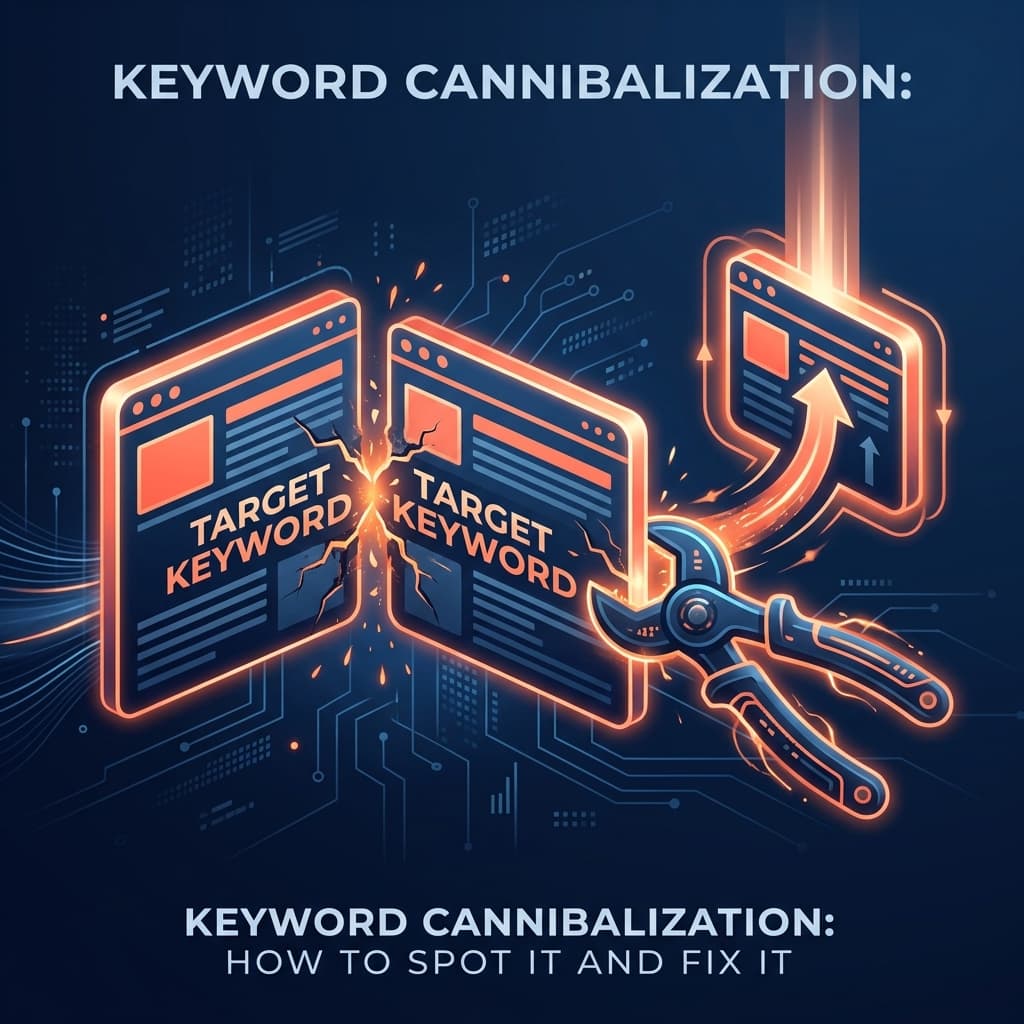
Keyword Cannibalization: How to Spot It and Fix It
You wrote a good post about email authentication in 2023. Then a better one in 2024, because you'd learned more. Then a third in 2025 covering DMARC specifically, which overlapped with both. Now none of them rank well, and Google keeps swapping which one it shows. That's cannibalisation. Your own pages competing for the same […]
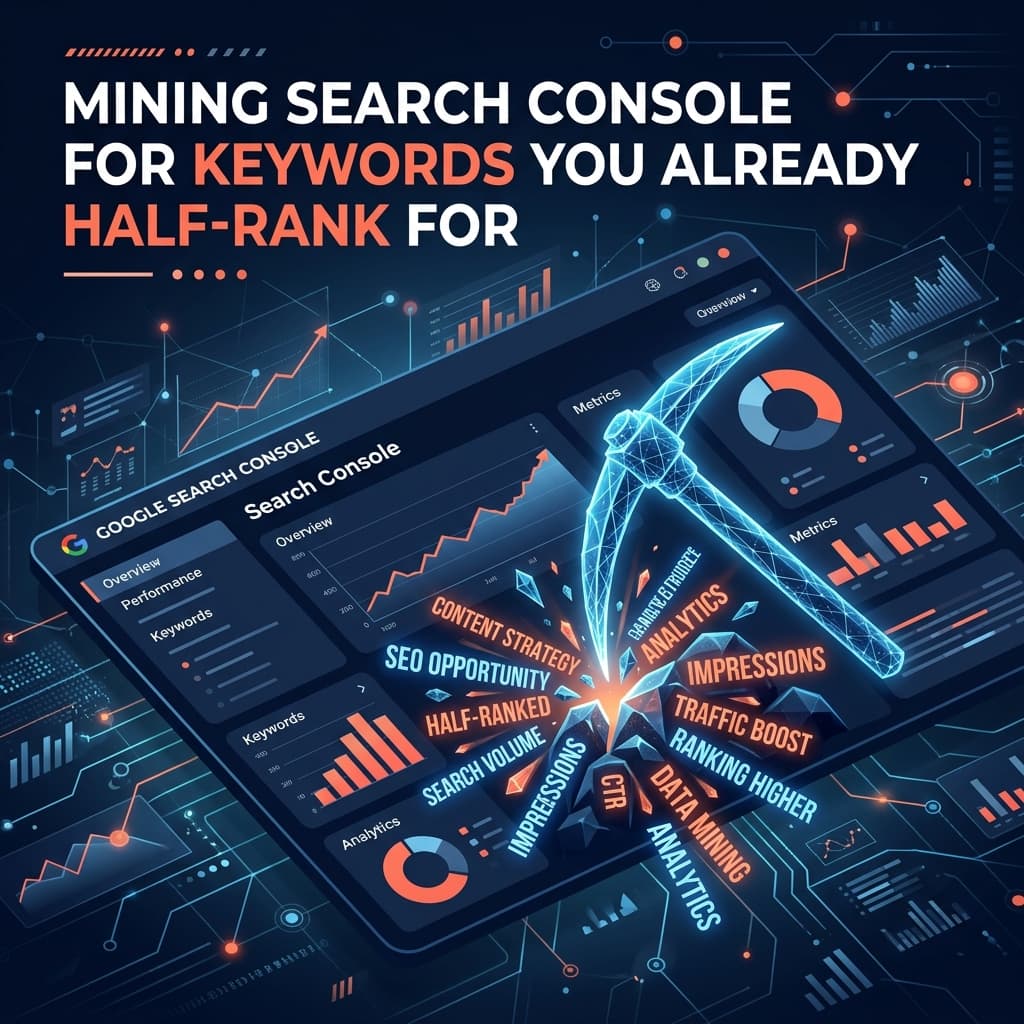
Mining Search Console for Keywords You Already Half-Rank For
There's a list sitting in your Search Console right now of keywords Google has already decided you're relevant for, where you're ranking just badly enough that nobody sees you. Nobody looks at it. Everybody buys a keyword tool instead. Those queries — roughly positions 8 through 20 — are the cheapest wins available on any […]
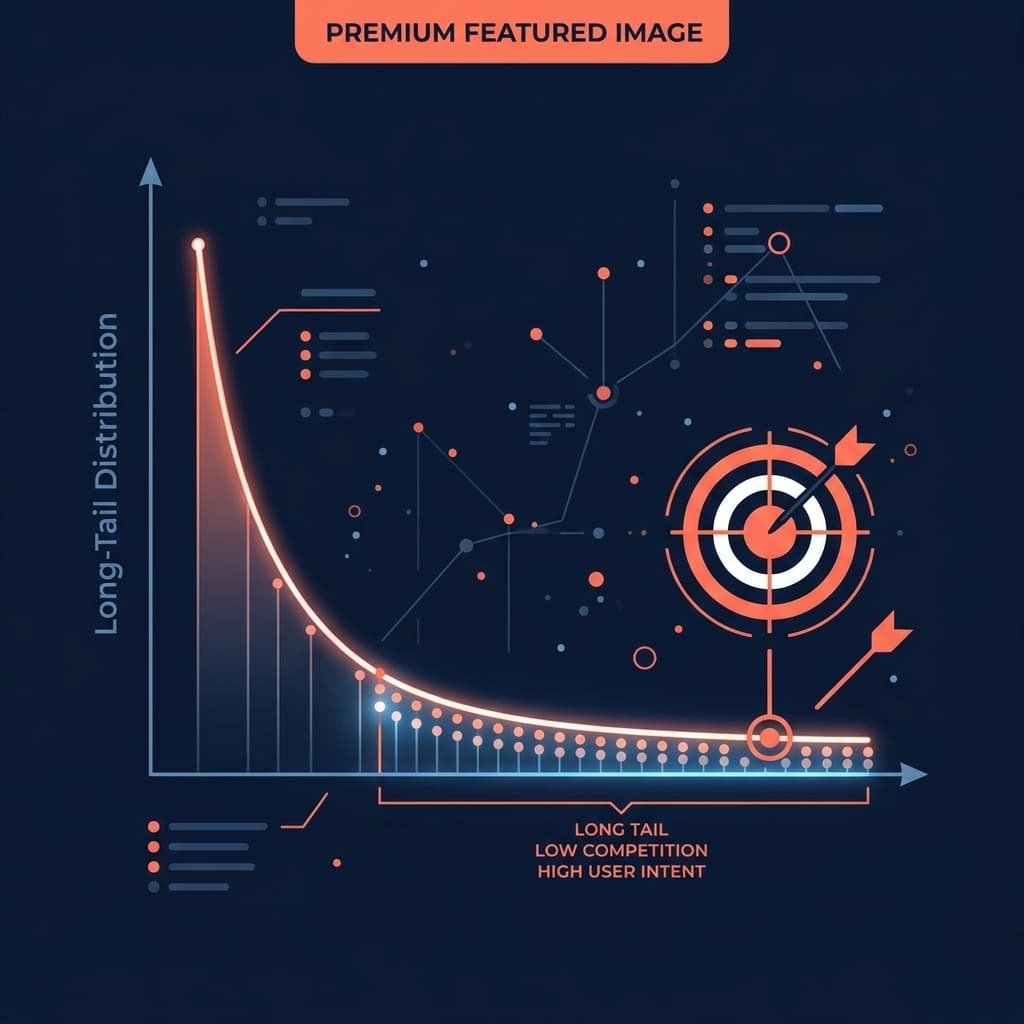
Long-Tail Keywords: Where a New Site Should Actually Start
Every new site owner wants to rank for the two-word term. "Email marketing." "Project management." "Running shoes." And every new site owner is competing there against domains with fifteen years of links, full-time content teams, and a brand people already search by name. You will not win that this year. You may not win it […]